큐와 메시지 패싱 — Producer-Consumer·Ring Buffer·전달 의미
#한 줄 요약
“공유 메모리 + lock보다 message passing” — 큐는 데이터와 동기화를 한 번에 처리합니다.
#Queue — Task 간 통신의 정답
Mutex와 공유 buffer 패턴을 먼저 보겠습니다.
SemaphoreHandle_t mtx;SharedBuffer_t shared;
void producer(void *arg) { while (1) { Data_t data = read_sensor(); xSemaphoreTake(mtx, portMAX_DELAY); shared.data = data; // ← race condition 위험 shared.ready = 1; xSemaphoreGive(mtx); }}
void consumer(void *arg) { while (1) { xSemaphoreTake(mtx, portMAX_DELAY); if (shared.ready) { Data_t data = shared.data; shared.ready = 0; } xSemaphoreGive(mtx); }}Polling이 필요하고 복잡합니다. 대안이 Queue입니다.
QueueHandle_t q = xQueueCreate(10, sizeof(Data_t));
void producer(void *arg) { while (1) { Data_t data = read_sensor(); xQueueSend(q, &data, portMAX_DELAY); }}
void consumer(void *arg) { Data_t data; while (1) { xQueueReceive(q, &data, portMAX_DELAY); // 자동 block process(data); }}Mutex와 signal, buffer가 통합되어 producer-consumer를 한 줄로 표현할 수 있습니다.
#Queue 내부 — Ring Buffer
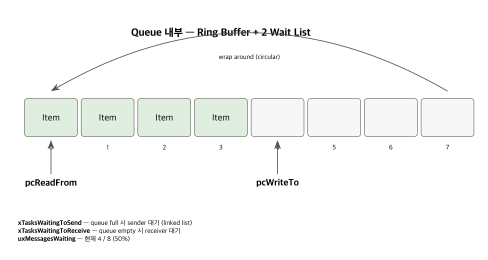
FreeRTOS의 큐 구현은 다음과 같습니다.
typedef struct QueueDefinition { int8_t *pcHead; // buffer 시작 int8_t *pcTail; // buffer 끝 int8_t *pcWriteTo; // 다음 write 위치 int8_t *pcReadFrom; // 다음 read 위치 UBaseType_t uxMessagesWaiting; // 현재 항목 수 UBaseType_t uxLength; // 최대 항목 수 UBaseType_t uxItemSize; // 각 항목 byte List_t xTasksWaitingToSend; // queue full 대기 List_t xTasksWaitingToReceive; // queue empty 대기} Queue_t;Ring buffer와 2개의 wait list로 구성됩니다. 송신자와 수신자 모두 block 가능합니다.
#Send/Receive 흐름
#Send
BaseType_t xQueueSend(QueueHandle_t q, const void *item, TickType_t timeout) { portENTER_CRITICAL(); if (q->uxMessagesWaiting < q->uxLength) { memcpy(q->pcWriteTo, item, q->uxItemSize); q->pcWriteTo += q->uxItemSize; if (q->pcWriteTo >= q->pcTail) q->pcWriteTo = q->pcHead; // wrap q->uxMessagesWaiting++; // Receive waiter 깨움 wake_first_waiter(&q->xTasksWaitingToReceive); portEXIT_CRITICAL(); return pdTRUE; } // Full — block add_to_wait_list(&q->xTasksWaitingToSend, current_task); portEXIT_CRITICAL(); block_with_timeout(timeout); /* ... 재시도 또는 timeout return */}#Receive
Send와 대칭입니다. Empty 시 xTasksWaitingToReceive에 block 하고, 새 item이 도착하면 wake 합니다.
#By-Value vs By-Reference
#By-Value (FreeRTOS 기본)
큐가 item 전체를 copy 합니다. 안전하지만 대용량 데이터에는 비효율적입니다.
typedef struct { uint8_t buf[1024]; // 1 KB int size;} BigMsg_t;
// 매 send마다 1024 byte memcpyQueueHandle_t q = xQueueCreate(5, sizeof(BigMsg_t));5개 × 1 KB = 5 KB의 큐 RAM이 필요하고, 매 send/receive마다 1 KB를 copy 해야 합니다.
#By-Reference (Pointer Queue)
Pointer만 큐에 넣어 copy가 없습니다. 빠르지만 수명 관리는 발신자와 수신자의 책임입니다.
QueueHandle_t q = xQueueCreate(5, sizeof(BigMsg_t *));
void producer(void *arg) { BigMsg_t *msg = pool_alloc(); // 메모리 풀에서 fill(msg); xQueueSend(q, &msg, portMAX_DELAY); // pointer만}
void consumer(void *arg) { BigMsg_t *msg; while (1) { xQueueReceive(q, &msg, portMAX_DELAY); process(msg); pool_free(msg); // 수신 후 해제 }}⚠️ 수명 관리가 까다롭습니다. sender가 msg를 재사용하거나 free 하면 데이터가 깨집니다. 메모리 풀과 결합해 쓰는 것이 좋습니다.
#Queue 변종
#Stream Buffer (FreeRTOS 10+)
바이트 stream 전용입니다(UART RX 등). 1
producer/consumer를 전제합니다.StreamBufferHandle_t sb = xStreamBufferCreate(256, 1);xStreamBufferSend(sb, data, len, timeout);xStreamBufferReceive(sb, buf, sizeof(buf), timeout);가변 길이이고 효율적입니다. Multi-producer 환경에서는 외부 동기화가 필요합니다.
#Message Buffer (FreeRTOS 10+)
가변 길이 message를 다룹니다. 각 message에 length prefix가 붙습니다.
MessageBufferHandle_t mb = xMessageBufferCreate(1024);xMessageBufferSend(mb, "Hello", 5, timeout);xMessageBufferSend(mb, "World!", 6, timeout);// Receive 시 정확히 5 byte, 그 다음 6 byte#Mailbox
큐가 항상 1 슬롯만 가집니다. 가장 최근 데이터만 유지하며, 옛 데이터를 덮어씁니다.
xQueueOverwrite(q, &data); // 큐 full이어도 OK, 옛것 덮어씀xQueuePeek(q, &data, 0); // 비파괴 read상태 broadcast(예: battery level)에 유용합니다.
#동기화 vs 통신
| 패턴 | 도구 |
|---|---|
| 자원 보호 (data integrity) | Mutex |
| 이벤트 알림 | Semaphore / Task Notification |
| 데이터 전달 | Queue |
| 가변 byte stream | Stream Buffer |
| 가변 길이 message | Message Buffer |
Queue는 데이터 전달과 동기화를 통합합니다. 가장 흔히 쓰이는 IPC입니다.
#Performance — Copy 비용
// 작은 데이터 (sizeof(Data_t) ≤ 32 byte)xQueueSend(q, &data, ...); // memcpy 32 byte ≈ 8 cycle on 32-bit MCU
// 큰 데이터 (1 KB)xQueueSend(q, &big, ...); // memcpy 1 KB ≈ 250 cycleARMv7-M memcpy는 약 4 byte/cycle입니다. 작은 message는 by-value로도 충분히 빠릅니다.
#ISR에서 사용
// ISRBaseType_t woken = pdFALSE;xQueueSendFromISR(q, &data, &woken);portYIELD_FROM_ISR(woken);Top-half ISR + Bottom-half task 패턴의 표준 도구입니다.
#Static 할당
StaticQueue_t q_buf;uint8_t q_storage[10 * sizeof(Data_t)];
QueueHandle_t q = xQueueCreateStatic( 10, // length sizeof(Data_t), // item size q_storage, // storage buffer &q_buf // queue control block);Safety-critical에서 표준으로 씁니다.
#자주 하는 실수
⚠️ Queue 가득 차 block 됨
xQueueSend 호출 시 queue가 full이면 sender가 block 됩니다. 의도와 다르다면 timeout=0으로 non-blocking 모드를 씁니다.
⚠️ By-reference 후 메모리 free
xQueueSend(q, &ptr, ...);free(ptr); // ← 수신자가 read 전에 free → crash수신자가 free 책임을 지거나 메모리 풀을 사용해야 합니다.
⚠️ ISR에서 normal queue send
xQueueSend()(FromISR 아님)를 호출하면 crash 합니다. 항상 FromISR 버전을 써야 합니다.
⚠️ Item size mismatch
xQueueCreate(10, sizeof(int))로 만들고 Data_t를 send 하면 memory corruption이 발생합니다. Item size 일치를 반드시 확인해야 합니다.
#정리
- Queue는 Ring buffer + 2 wait list 구조로, 데이터와 동기화를 통합합니다.
- **By-value(copy)**가 기본이며 안전합니다. **By-reference(pointer)**는 빠르지만 수명 관리가 필요합니다.
- 변종으로 Stream Buffer(byte), Message Buffer(가변), Mailbox(overwrite)가 있습니다.
- ISR과 task 사이의 표준 패턴입니다.
다음 편(Part 1 마지막)에서는 실시간성 분석으로 Latency, Jitter, Deadline, WCET를 다룹니다.
#관련 항목
Practical RTOS Internals · 10 of 53
- 1 Practical RTOS Internals — 실시간 커널 내부 분석 시리즈 소개
- 2 RTOS가 필요한 이유 — 일반 OS와의 결정적 차이
- 3 Task와 Thread 개념 — TCB·상태 머신·생명 주기 분석
- 4 실시간 스케줄링 알고리즘 비교 — RR·Priority·EDF·RMS
- 5 Preemption과 Cooperation — 강제 전환 vs 자발 양보
- 6 인터럽트와 RTOS — ISR Context·Deferred Processing·FromISR API
- 7 동기화 기초 분석 — Critical Section·Mutual Exclusion·Race Condition
- 8 Semaphore 개념 분해 — Counting·Binary·P/V 연산
- 9 Mutex 개념 분해 — Ownership·Recursive·Priority Inheritance
- 10 큐와 메시지 패싱 — Producer-Consumer·Ring Buffer·전달 의미
- 11 실시간성 분석 — Latency·Jitter·Deadline·WCET·RMA
- 12 Ready List 자료구조 분석 — Linked List·Bitmap·O(1) Scheduler
- 13 Blocked List 자료구조 — Timeout 정렬·Delta List·Two-List Scheme
- 14 Scheduler 알고리즘 구현 추적 — Next-Task Selection 로직
- 15 Context Switch 원리 분석 — 레지스터 저장·복원·Stack Frame
- 16 ARM Cortex-M Context Switch — PendSV·MSP/PSP 어셈블리 추적
- 17 ARM Cortex-A Context Switch — Mode 전환·SVC·Banked Registers
- 18 RISC-V Context Switch 분석 — ECALL·mret·CSR
- 19 RTOS Tick과 타이머 — SysTick·Generic Timer·configTICK_RATE_HZ
- 20 Tickless 모드 구현 — Idle Tick Suppression·Sleep·Wake 보정
- 21 Scheduler Latency 측정 기법 — GPIO Toggle·DWT·ftrace·cyclictest
- 22 RTOS Tracing과 Observability — Tracealyzer·SystemView·ITM/ETM
- 23 Critical Section 구현 비교 — IRQ Disable·BASEPRI·Spinlock
- 24 Semaphore 내부 구현 추적 — Counter·Wait List·ISR-Safe Variant
- 25 Mutex 내부 구현 추적 — Owner·Recursion Count·ISR 금지
- 26 Priority Inversion 문제 — Mars Pathfinder 사례·Bounded vs Unbounded
- 27 Priority Inheritance 구현 — Inherit·Disinherit·Chain
- 28 Priority Ceiling Protocol — Immediate vs Original 비교
- 29 Queue 내부 구현 추적 — Ring Buffer·2 Wait Lists·Atomic Send/Receive
- 30 Event Group 분석 — Bit Flag·AND/OR Wait·Sync Barrier
- 31 ISR-Safe API 설계 — FromISR 패턴·Higher Priority Wake·Deferred Work
- 32 Deadlock 분석 — 4 조건·Wait-for Graph·Lock Ordering·Timeout
- 33 Stream Buffer와 Message Buffer — FreeRTOS 10의 Lock-Free SPSC
- 34 실시간 메모리 요구사항 — Determinism·Fragmentation·WCET
- 35 FreeRTOS Heap_1~5 분석 — 5종 Allocator의 구조와 트레이드오프
- 36 TLSF Allocator 분석 — Two-Level Segregated Fit O(1)
- 37 Static Allocation — 컴파일 타임으로 동적 위험 제거하기
- 38 Memory Pool — Fixed-Size Block Allocator의 단순함과 강력함
- 39 Stack Overflow 탐지 — Canary·MPU·Watermark 3중 방어
- 40 SMP RTOS 설계 — Ready List·Affinity·IPI·Load Balancing
- 41 SMP Spinlock 구현 — LDREX/STREX·Ticket Lock·MCS·WFE/SEV
- 42 Software Timer 분석 — Daemon Task·자료구조·ISR-Safe API
- 43 RTOS System Call — SVC·ECALL·User/Kernel 분리·FreeRTOS-MPU
- 44 TrustZone과 TF-M — Secure/Non-Secure·NSC Veneer·PSA
- 45 AMP와 OpenAMP — Heterogeneous SoC·RPMsg·remoteproc
- 46 C++ in RTOS — RAII·std::thread·ETL·Coroutine
- 47 FreeRTOS 소스 분석 — tasks.c·queue.c·port.c 추적
- 48 Zephyr 커널 분석 — k_thread·k_sem·Driver Model
- 49 RT-Thread 분석 — Object 모델·Components·Smart·Studio
- 50 RTOS 포팅 가이드 — 새 아키텍처에 옮기는 절차
- 51 RTOS 선택 가이드 — Footprint·License·Certification·Ecosystem
- 52 Apache NuttX 분석 — POSIX·PX4·NASA Ingenuity
- 53 PREEMPT_RT Linux — Mainline 6.12·Xenomai 4·EVL
관련 글
실시간성 분석 — Latency·Jitter·Deadline·WCET·RMA
4 핵심 지표인 Latency, Jitter, Deadline, WCET를 다룹니다. Hard와 Soft real-time의 차이, Rate Monotonic Analysis로 schedulability를 증명하는 방법을 살펴봅니다.
같은 시리즈에서 이어 읽기
Ready List 자료구조 분석 — Linked List·Bitmap·O(1) Scheduler
Ready 상태 task를 보관하는 자료구조 선택이 곧 스케줄러 latency를 결정합니다. FreeRTOS의 array-of-lists, bitmap + CLZ 최적화, uC/OS의 8×8 LUT까지 한 번에 정리합니다.
같은 시리즈에서 이어 읽기
Lock-free Container 구현 — SPSC Queue·Ring Buffer
SPSC queue, MPMC stack, ring buffer — lock-free 자료구조 구현 패턴.
공통 태그 기반 추천
이 글을 참조하는 글 (4)
- RTOS Queue 활용 — By-Value·By-Reference·Timeout 패턴 — Modern Embedded Recipes
- Queue 내부 구현 추적 — Ring Buffer·2 Wait Lists·Atomic Send/Receive — Practical RTOS Internals
- 실시간성 분석 — Latency·Jitter·Deadline·WCET·RMA — Practical RTOS Internals
- Mutex 개념 분해 — Ownership·Recursive·Priority Inheritance — Practical RTOS Internals