Interrupt Latency 분석 — 진입·종료·Tail-Chaining·Late Arrival
#한 줄 요약
“Interrupt latency는 IRQ 발생부터 ISR의 첫 명령까지 걸리는 시간입니다.” 짧을수록 real-time 응답이 강력해집니다.
#Cortex-M Interrupt Latency
| CPU | Cycle | @ 168 MHz |
|---|---|---|
| Cortex-M0 | 16 | 95 ns |
| Cortex-M0+ | 15 | 89 ns |
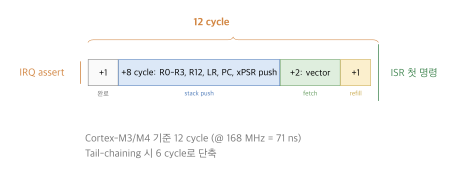
| Cortex-M3 | 12 | 71 ns |
| Cortex-M4 | 12 | 71 ns |
| Cortex-M7 | 12 (lower with cache) | 71 ns |
| Cortex-M33 | 11 | 65 ns |
내부적으로는 8개 register의 hardware push와 vector fetch, pipeline refill로 구성됩니다.
#Tail-Chaining - 핵심 트릭
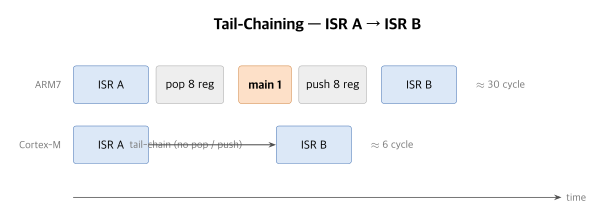
연속 IRQ 상황에서 50% 효율을 얻습니다.
#Late Arrival
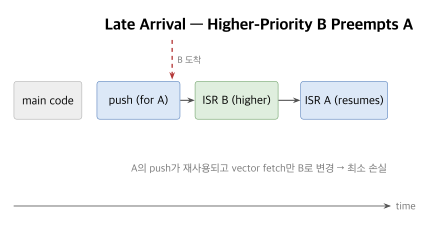
Higher priority IRQ가 최소 손실로 선점합니다. Cortex-M3 이상의 표준 동작입니다.
#Lazy Stacking (M4·M7 with FP)
FPU를 사용할 때는 16개 floating register를 추가로 push해야 해서 latency가 32 cycle 더 늘어납니다.
ISR 진입 시 FPU context는 *push하지 않음* (lazy)ISR이 FPU 명령을 쓰면 그때 push (lazy stacking trigger)ISR이 FPU를 안 쓰면 push 자체를 생략 (latency 절약)FPU->FPCCR |= FPU_FPCCR_LSPEN_Msk; // lazy stacking enable (기본)FPU->FPCCR &= ~FPU_FPCCR_LSPEN_Msk; // disable - 항상 push#IRQ 진입·종료 시간 측정하기
volatile uint32_t isr_entry_cycle;
void EXTI0_IRQHandler(void) { isr_entry_cycle = DWT->CYCCNT; // ← 진입 시점 /* ... */ EXTI->PR1 = EXTI_PR1_PIF0;}
/* Main */__DSB();uint32_t t = DWT->CYCCNT;EXTI->SWIER1 |= EXTI_SWIER1_SWI0; // soft trigger IRQ__DSB();uint32_t latency = isr_entry_cycle - t;printf("Latency: %u cycle\n", latency);#ISR 처리 시간 단축 - Top-Half / Bottom-Half
volatile uint32_t flag;
void UART_IRQHandler(void) { /* Top half - *짧게* */ uint8_t byte = UART->RDR; ring_buffer_put(byte); flag = 1; // signal}
void main_loop(void) { if (flag) { flag = 0; process_packet(); // Bottom half - task context }}RTOS에서는 semaphore와 event group으로 bottom half를 깨웁니다.
void UART_IRQHandler(void) { BaseType_t hp = pdFALSE; uint8_t byte = UART->RDR; xQueueSendFromISR(rx_queue, &byte, &hp); portYIELD_FROM_ISR(hp);}#NVIC Priority Grouping
NVIC_SetPriorityGrouping(3); // 4 group, 4 sub-priorityNVIC_SetPriority(EXTI0_IRQn, NVIC_EncodePriority(3, 1, 0)); /* group, preempt, sub */- Preempt priority가 높으면 다른 IRQ를 선점할 수 있습니다.
- Sub priority는 pending 중인 IRQ의 선택 순서를 결정합니다.
같은 preempt 그룹이면 먼저 발생한 IRQ가 먼저 처리됩니다. Critical signal에는 높은 preempt를 줍니다.
#Critical Section - IRQ Disable
__disable_irq();/* critical */__enable_irq();Disable 동안 모든 IRQ가 차단되어 response 시간이 늘어납니다. 최대 disable 시간을 측정하는 것이 곧 worst-case latency 측정입니다.
#BASEPRI - Selective Disable
__set_BASEPRI(0x40); // priority 4 이상 차단, 0-3는 통과/* critical, 그러나 high IRQ는 처리됨 */__set_BASEPRI(0);FreeRTOS의 portENTER_CRITICAL이 BASEPRI를 사용합니다.
#Cortex-A - GIC IRQ Latency
| 단계 | Cycle |
|---|---|
| Distribute → CPU IF | ~5 |
| Acknowledge (read GIC) | ~10 |
| Pipeline flush·context save | ~30 (OoO 시) |
| ISR 진입 | ~50 cycle |
Cortex-A53 1 GHz 기준으로 50 ns 수준입니다. 다만 cache miss와 OoO drain이 겹치면 수백 cycle까지 늘어납니다.
자동차 brake와 airbag처럼 sub-µs response가 필요한 곳에서는 Cortex-R5(in-order, 8-cycle IRQ)를 씁니다.
#IRQ Storm 회피
void timer_isr(void) { /* 매 µs 트리거 - CPU를 다 잡아먹음 */}해결책은 다음과 같습니다.
- Coalescing으로 N개 이벤트마다 한 번만 처리합니다.
- Polling 전환은 매우 빈번한 이벤트에 적합합니다.
- DMA로 IRQ 자체를 회피하는 방법도 있습니다.
#FreeRTOS의 ISR Overhead
configMAX_SYSCALL_INTERRUPT_PRIORITY = 5 가정IRQ priority 5+ - FromISR API 사용 → entry: 12 cycle (hardware) → kernel hook: ~30 cycle → bottom half wake: ~50 cycle → portYIELD_FROM_ISR: pendSV pending → return + PendSV: ~100 cycle (context switch) Total: ~200 cycle
IRQ priority 0-4 (configMAX_SYSCALL 위) - 직접 hardware ISR → entry: 12 cycle → ISR work만 → exit: 12 cycle Total: ~25 cycle (FreeRTOS 비관여)Hard real-time IRQ는 configMAX_SYSCALL 위에 두고 RTOS API를 쓰지 않습니다.
#ISR 안에서 lock 금지
void ISR(void) { xSemaphoreTake(mtx, ...); // 차단될 수 있어 hard fault로 이어집니다}*FromISR이나 hardware-only IRQ를 써야 합니다.
#자주 하는 실수
⚠️ Long ISR
void ADC_IRQ(void) { process_sample(); // 빠름 calculate_fft(); // 수 ms 걸리며 다른 IRQ를 차단합니다}FFT는 task로 defer해야 합니다.
⚠️ Disable IRQ 너무 김
__disable_irq();xSemaphoreTake(sem, portMAX_DELAY); // block + IRQ 차단으로 deadlockCritical section은 수 µs 이내로 유지해야 합니다.
⚠️ Tail-chaining 효과 무시
작은 ISR 여러 개와 한 큰 ISR을 비교해 보면 작은 ISR 여러 개가 더 빠를 수도 있습니다 (tail-chain 활용).
⚠️ FPU stacking overhead 미인식
FP를 사용하지 않을 때는 lazy stacking을 활용합니다. FPU register를 clobber하는 함수를 IRQ 안에서 호출하는 것은 권장하지 않습니다.
#정리
- Cortex-M의 IRQ latency는 M3와 M4 기준 12 cycle입니다.
- Tail-chaining은 6 cycle, late arrival은 seamless하게 선점합니다.
- Lazy FP stacking은 M4/M7의 latency를 줄여 줍니다.
- ISR top half는 짧게 유지하고 bottom half는 task로 미룹니다.
BASEPRI로 선택적 disable을 걸면 high IRQ는 통과시킬 수 있습니다.- Hard real-time IRQ는 configMAX_SYSCALL 위에 둡니다.
다음 편은 Interrupt Storm을 다룹니다.
#관련 항목
Embedded Performance Engineering · 24 of 57
- 1 Embedded Performance Engineering — 임베디드 성능 엔지니어링 시리즈 소개
- 2 임베디드 성능 분석 방법론 — Measure → Analyze → Optimize 사이클
- 3 성능 지표 정의 — Latency·Throughput·Utilization 분석
- 4 성능 측정의 기본 — Wall-Clock·CPU Cycle·Instruction Count
- 5 성능 데이터 통계적 분석 — Percentile·Histogram·평균의 함정
- 6 실시간 성능 분석 — WCET·Jitter·Deadline Miss 측정
- 7 임베디드 벤치마킹 기초 — 재현성·Warmup·노이즈 제거
- 8 성능 모델링 — Amdahl·Gustafson·Roofline Model 적용
- 9 프로파일링 기법 개요 — Sampling vs Instrumentation·PGO·LTO
- 10 CPU 파이프라인 분석 — 5-stage·Cortex-M·Cortex-A 비교
- 11 Pipeline Stall 분석 — Data·Structural·Control Hazard·Forwarding
- 12 Branch Prediction 분석 — Static·2-bit·BTB·BHT·Mispredict 비용
- 13 Speculative Execution 분석 — OoO·Reorder Buffer·Register Renaming
- 14 CPU Cache 기초 — L1·L2·L3·Set Associative·Replacement Policy
- 15 Cache Miss 3C Model 분석 — Compulsory·Capacity·Conflict
- 16 Cache Line 최적화 — Alignment·Prefetch·False Sharing 처리
- 17 메모리 대역폭 분석 — STREAM·Roofline·Bus Saturation 측정
- 18 SIMD·NEON 활용 — 128-bit Vector·Auto-Vectorization·SVE/SVE2
- 19 PMU·HPM 하드웨어 카운터 분석 — 정밀 성능 진단
- 20 임베디드 Bus Architecture — AHB·AXI·CHI 진화와 5-Channel
- 21 Bus Contention 진단 — Arbitration·QoS·Starvation 측정
- 22 DMA 성능 최적화 — Burst·Scatter-Gather·Chain·Cache 일관성
- 23 DMA vs CPU Copy 성능 비교 — Break-even·Setup Overhead 실측
- 24 Interrupt Latency 분석 — 진입·종료·Tail-Chaining·Late Arrival
- 25 Interrupt Storm 처리 — NAPI·Rate-Limit·Polling 전환
- 26 MMIO 접근 성능 — Cache Policy·Write-Combining·Volatile·Barrier
- 27 Peripheral Clock 분석 — PLL·Divider·Gating·DVFS
- 28 Power vs Performance 트레이드오프 — DVFS·Race-to-Idle·Big.LITTLE
- 29 Thermal Throttling 분석 — Junction Temp·Trip Point·냉각
- 30 CXL Interconnect 분석 — AI 시대 메모리 대역폭 확장
- 31 Concurrency 기초 — Concurrency vs Parallelism·Race·Memory Model
- 32 False Sharing 진단 — Cache Line Ping-Pong·Padding·측정
- 33 Lock Contention 분석 — Wait·Hold·Convoy·측정 기법
- 34 Spinlock 성능 분석 — Spin-Wait vs Context Switch·Ticket·MCS
- 35 Mutex 성능 분석 — Futex·Adaptive·Priority Inheritance
- 36 Reader-Writer Lock 성능 — Reader/Writer Priority·RCU·Seqlock
- 37 Lock-Free 자료구조 성능 — CAS·ABA·Hazard Pointer·Epoch Reclamation
- 38 Memory Ordering 분석 — Acquire·Release·Seq-Cst·ARM Relaxed Model
- 39 Cache Coherency 프로토콜 — MESI·MOESI·Snoop·Directory
- 40 SMP 성능 분석 — Per-Core·Affinity·Load Balance·Scalability
- 41 Linux perf 기초 — stat·record·report 활용
- 42 Linux perf 고급 — Raw Event·Tracepoint·perf script
- 43 ftrace 활용 — function·function_graph·latency tracer
- 44 eBPF·bpftrace 동적 트레이싱 — 커널 무수정 관측
- 45 Flamegraph 분석 — On-CPU·Off-CPU·Differential
- 46 ARM DS·Lauterbach 분석 — Hardware Trace 전문 도구
- 47 Bare-metal 프로파일링 — GPIO·DWT·SysTick·ITM 활용
- 48 NVIDIA Nsight Systems — GPU·NPU 포함 시스템 분석
- 49 모던 프로파일러 비교 — Tracy·Hotspot·uftrace·Coz
- 50 연속 프로파일링 — Parca·Pixie·Pyroscope·Tetragon
- 51 실전 사례 — ISR Latency 100µs Deadline Miss 추적
- 52 실전 사례 — Matrix Multiply가 예상의 10배 느린 이유
- 53 실전 사례 — 8-core가 4-core를 넘으면 throughput이 떨어지는 이유
- 54 실전 사례 — 카메라 1080p 60fps가 30fps로 떨어지는 이유
- 55 CXL.mem 지연·대역폭 실측 — Direct·Switch·Pooled 토폴로지 비교
- 56 CXL 성능 프로파일링 도구 — cxl-cli·DAMON·perf-mem 활용
- 57 실전 사례 — CXL.mem 추가로 LLM inference KV cache 처리량 회복
관련 글
Interrupt Storm 처리 — NAPI·Rate-Limit·Polling 전환
IRQ flooding으로 main loop 봉쇄. NAPI 패턴, rate limit, interrupt coalescing.
같은 시리즈에서 이어 읽기
MMIO 접근 성능 — Cache Policy·Write-Combining·Volatile·Barrier
MMIO uncached strongly-ordered. Write-combining for PCIe BAR. Volatile, DMB·DSB·ISB.
같은 시리즈에서 이어 읽기
ESP32-C3 RISC-V 코어 분석 — RV32IMC·PMP·인터럽트 컨트롤러
ESP32-C3 코어의 ISA·특권 모델·인터럽트. 32-bit IMC, M-mode only, PMP 16 entries.
공통 태그 기반 추천
이 글을 참조하는 글 (6)
- DMA Completion 메커니즘 — Interrupt·Polling·Completion Ring — Modern Embedded Recipes
- IRQ Affinity 튜닝 — smp_affinity·isolcpus·irqbalance — Modern Embedded Recipes
- 실전 사례 — 카메라 1080p 60fps가 30fps로 떨어지는 이유 — Embedded Performance Engineering
- 실전 사례 — ISR Latency 100µs Deadline Miss 추적 — Embedded Performance Engineering
- Interrupt Storm 처리 — NAPI·Rate-Limit·Polling 전환 — Embedded Performance Engineering
- DMA vs CPU Copy 성능 비교 — Break-even·Setup Overhead 실측 — Embedded Performance Engineering